ADHD Is a Misleading Label: The Real Struggle Is Time Blindness
ADHD isn't an attention problem. It's executive dysfunction and time blindness: a brain that only knows now and not now. What that costs, and how to work with it.
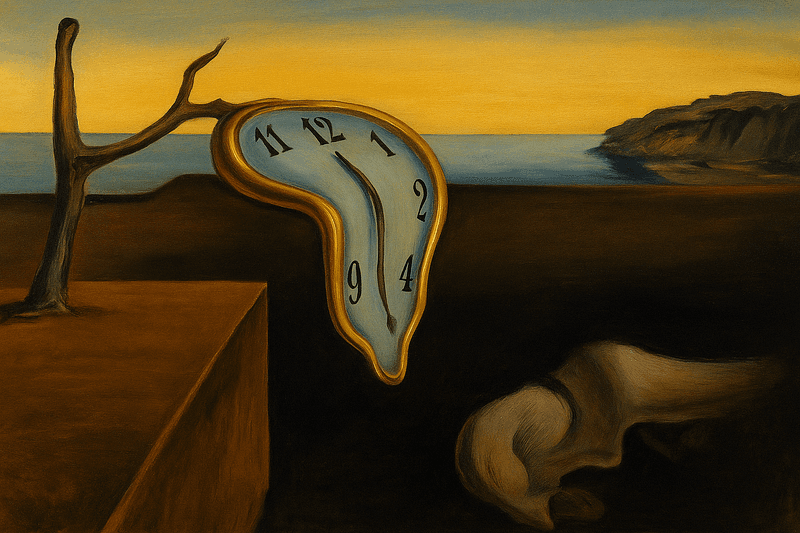
ADHD is one of the most misleading labels we’ve ever created. “Attention Deficit Hyperactivity Disorder.” From the outside, it looks like an inability to sit still, an attention problem, a restless child who can’t focus in class. But that’s just the surface. Those are symptoms.
The real story is deeper: executive dysfunction and dopamine dysregulation. Your brain’s management system doesn’t run the way it’s supposed to. The reward chemistry is off. And one of the most brutal consequences is something rarely talked about: time blindness.
Time blindness means the clock inside your head is broken. The future doesn’t feel real. You don’t sense time as a smooth flow but as a binary: now or not now. Deadlines arrive like ambushes. Tasks expand endlessly because your brain can’t predict how long they’ll take. You overcommit, underdeliver, and then spiral into shame.
That shame is where my anxiety began. I’ve since come to believe the two run as a single reinforcing loop — but back then, I only felt the weight.
For most of my life, I didn’t know I had ADHD. I just thought I was failing at being a normal human. I’d try to plan my weeks, build systems, make promises — and then watch them collapse.
Monday mornings were the worst. If I opened my calendar and it was blank, I felt the panic of a void: Where do I even start? But if the calendar was crammed full of meetings and tasks, all with equal weight, I felt suffocated.
Either way — total freedom or total structure — my anxiety spiked. What I needed wasn’t more or less in my calendar. I needed a framework that gave me freedom without strangling me.
I once had a vision in meditation that showed me exactly what this meant. I saw a herd of mustang horses — wild, untamed, jumping in every direction. Then walls closed in from both sides, guiding their movement.
Suddenly, the mustangs aligned. They began to run straight ahead, hooves pounding the ground, the air thick with energy. From my perspective, it was as if I was sitting on a cart behind them, being carried forward with unstoppable force.
The message was clear: my attention is like those wild horses. Scattered, they exhaust themselves. Framed, they become unstoppable. If I could build the right frame, my inner mustangs would carry me anywhere I wanted to go.
How to Solve It
NASA engineer Ali Alqaraghuli has a great way of putting it: productivity is subtractive, not additive. Most advice says add more apps, add more templates, add more hacks. But for ADHD brains, that just creates clutter. Step one is subtraction: remove distractions, toxic commitments, and pointless obligations. Clear the runway.
Once you subtract, the system you build has to solve four core problems:
1. Clarity
If the goal isn’t clear, you’ll spin in circles. Write down exactly what you’re aiming for and why. For me, this meant asking: What’s the one thing today that really matters? Not ten things. One.
2. Prioritization
ADHD brains chase novelty. To cut through noise, prioritize based on the biggest obstacle. Ask: What’s blocking me right now? If I solved this, would the rest move forward?
3. Time
Don’t rely on your internal clock — it’s broken. Externalize time everywhere. Use timers, visual clocks, and micro-deadlines. Ali suggests an “opt-out” approach: instead of asking when should I do this? ask why can’t I do it right now? That flips the default to action.
4. Execution
Most people think execution is just about grit. But for ADHD brains, it’s about self-talk. Resistance often comes from perfectionism and fear of failure. A trick that saved me: instead of telling myself “I must succeed,” I told myself “I’ll try this, and if I fail, I’ll try again.” Failure became part of the plan, not the end of the story.
Breaking the Loop
When I started applying these principles, the anxiety loop began to break. Externalizing time meant I stopped waking up to panic about forgotten deadlines. Subtracting distractions meant I could finally breathe.
Reframing failure meant my perfectionism stopped strangling me. And creating a framework that balanced freedom with structure meant I no longer dreaded Mondays — because my calendar became a guide, not a prison.
ADHD didn’t go away. Anxiety didn’t disappear. But the story changed. Instead of seeing myself as broken, I started seeing my brain as a different model — one that needed a custom operating manual. And once I stopped fighting my wiring, I could finally build with it.
If you live with ADHD and anxiety, I want you to hear this: the problem isn’t you. The problem is the wrong story you’ve been told. You don’t need more shame. You need systems. You need subtraction. And you need to stop measuring yourself against a clock that was never designed for you in the first place.