Avoidance vs. Escape Learning — When Leaving Is Actually Self-Leadership
Textbook definitions explain what we do, not why. When leaving a situation feeds your anxiety loop — and when it's actually self-leadership.

Linh Nguyen on Unsplash
If you’ve searched for avoidance vs. escape learning, you’ve probably found explanations like these:
- Avoidance learning means preventing exposure to a feared situation before it happens.
- Escape learning means leaving a situation after you’ve already entered it.
Both reduce anxiety through negative reinforcement, which is why both can unintentionally keep anxiety alive.
Those definitions are correct.
But after spending years recovering from anxiety myself — and reading almost everything I could find on exposure therapy, inhibitory learning, and nervous system recovery — I realized they were also incomplete.
They explain what we do.
They don’t answer the question that actually matters when you’re standing in the middle of an anxious moment:
How do you know whether leaving is fear… or wisdom?
That question haunted me for years.
Because anyone recovering from anxiety eventually faces the same dilemma.
Should I stay?
Should I leave?
Am I expanding my nervous system?
Or am I simply pushing myself too hard?
The more I searched, the more I noticed that almost every article treated the problem as if there were only two options.
Avoidance.
Or exposure.
My own experience suggested something different.
I think there’s a third option.
But it took one unbearably hot weekend on a campsite to finally understand what it was.
It was one of the hottest weekends of the year.
My parents had parked their camper at a campsite by a beautiful lake, and I had packed my tent, my paddle board and enough food for what I imagined would be a relaxing weekend. We’d spend the day on the water, barbecue in the evening and play cards before heading to bed.
It sounded exactly like the kind of weekend I needed.
The strange thing is…
I almost didn’t go.
Nothing had happened yet.
I was still at home in Hamburg, loading my car.
But something already felt off.
If you’ve lived with anxiety for long enough, you probably know that feeling.
Your nervous system starts predicting danger long before reality has given it a reason.
There’s no evidence.
No obvious trigger.
Just a quiet sense that maybe staying home would be the smarter decision.
Years ago, I would have listened.
I would have called my parents, made up an excuse and stayed home.
This time I made a different deal with myself.
“Let’s just see what happens.”
Not because I was convinced everything would be fine.
But because I’d learned something important.
Predictions deserve curiosity — not obedience.
As I drove toward the campsite, I could feel the anxiety slowly building.
Nothing dramatic.
Just a growing feeling that I was heading toward something my nervous system didn’t like.
Then I arrived.
And suddenly it made sense.
The campsite wasn’t just another campsite.
Eight years earlier, during one of the darkest periods of my anxiety, I’d spent time there.
Back then, my world had become incredibly small. Every outing felt like a survival exercise. My parents were one of the few places where I still felt safe, and I’d joined them on camping trips simply because being close to them made life feel manageable.
Standing there again, I realized something my conscious mind hadn’t remembered during the drive.
My nervous system had.
The place itself had become associated with one of the hardest chapters of my life.
As if that wasn’t enough, the campsite looked exactly like my anxious mind loves to interpret as threatening.
It was run down.
Crowded.
Chaotic.
Nothing like the peaceful image I’d created in my head.
Within minutes, my mind started building its case.
“This was a mistake.”
“You should have stayed home.”
“Just pack up and drive back.”
The arguments felt convincing.
They always do.
Then the first night arrived.
The heat inside my tent was unbearable.
It felt less like camping and more like sleeping inside a sauna.
Opening the tent helped for about ten seconds before the mosquitoes discovered the buffet.
The campsite next door kept playing music until almost four in the morning.
I barely slept.
Lying there in the dark, sweaty and exhausted, listening to the bass echo across the campsite, every anxious prediction suddenly felt true.
Maybe I’d pushed myself too far.
Maybe I’d ignored my intuition.
Maybe recovery didn’t mean forcing myself through weekends like this.
I could leave first thing in the morning.
Nobody would blame me.
My parents certainly wouldn’t.
Then a question appeared that I’ve learned to ask whenever anxiety starts making life feel urgent.
If I leave tomorrow morning… whose decision will that actually be?
Mine?
Or my nervous system’s?
That single question quietly changed the way I think about anxiety.
Because I realized something that none of the articles I’d read had ever really answered.
The problem isn’t simply avoiding.
The problem isn’t simply escaping.
The real question is whether anxiety has already made the decision before you have.
That realization sent me back to the psychology.
I wanted to know whether science already had an answer.
It turned out that it had part of one.
What Psychology Gets Right About Avoidance and Escape Learning
When I went back to the research, I realized the psychology was remarkably accurate.
It just wasn’t complete enough to answer the question I was asking.
Here’s the distinction.
Avoidance learning happens when you prevent exposure altogether.
You don’t board the plane.
You cancel the dinner.
You decide not to go on the trip because your brain predicts that something bad might happen.
Escape learning begins after you’ve already entered the situation.
You get on the plane — but ask to get off before takeoff.
You arrive at the party — but leave after ten minutes because the anxiety becomes overwhelming.
Although the behaviors look different, they’re maintained by the same learning mechanism.
Both produce immediate relief.
And the nervous system loves immediate relief.
Every time anxiety drops immediately after avoiding or escaping, your brain quietly updates one prediction:
Leaving worked.
Psychologists call this negative reinforcement.
The relief itself becomes the reward.
Your brain isn’t trying to make your life smaller.
It’s trying to become a better predictor.
From its perspective, it has just discovered something useful.
“The last time we left, we survived.”
So the next time a similar situation appears, it makes the same recommendation.
Leave earlier.
Avoid sooner.
Find certainty faster.
That’s why anxiety can slowly shrink your world.
Not because more places become dangerous.
But because your nervous system becomes increasingly convinced that safety always exists somewhere else.
Modern anxiety research has added another important insight.
Recovery isn’t about convincing yourself that nothing bad can happen.
It’s about giving your nervous system enough new experiences that it begins questioning its old predictions.
Researchers call this inhibitory learning.
Instead of erasing old fear memories, your brain gradually builds stronger, competing memories.
“I thought I couldn’t handle this.”
“But apparently I could.”
That’s why exposure therapy can be so effective.
Not because it forces fear to disappear.
But because it gives your brain the opportunity to discover that its predictions aren’t always true.
If you’ve ever recovered from anxiety, you’ve probably experienced this yourself.
The first time you drove on the highway again.
The first dinner with friends.
The first flight.
The first vacation.
Nothing magical happened.
The anxiety didn’t vanish overnight.
Instead, your nervous system slowly collected evidence that reality wasn’t unfolding the way it had expected.
I think the science gets all of that right.
But sitting on that campsite the next morning, another question kept bothering me.
If recovery is about creating new learning…
How do you know when staying creates learning — and when staying has simply turned into suffering?
Because those don’t feel like the same thing.
And I couldn’t find a satisfying answer anywhere.
That’s where I think the conversation needs another layer.
Not instead of psychology.
On top of it.
Where Psychology Ends and Self-Leadership Begins
Imagine two people standing at the exit of the same party.
Both are anxious.
Both are thinking about leaving.
Both eventually walk out the door.
From the outside, their behavior is identical.
According to most explanations of avoidance and escape learning, that’s where the story ends.
I don’t think that’s where it ends at all.
I think that’s where the interesting part begins.
Because behavior alone doesn’t tell us what the nervous system learned.
Timing does.
The first person arrives, feels overwhelmed and leaves twenty minutes later because anxiety becomes unbearable.
The second person feels exactly the same anxiety.
But instead of reacting immediately, they stay just a little longer.
Not until they’re perfectly calm.
Not until they suddenly love the party.
Just long enough for the first wave of urgency to soften.
An hour later they realize something surprising.
They’re simply tired.
They’ve had enough social interaction for one day.
They hug their friends goodbye and head home.
Both people left.
But I don’t think they taught their nervous systems the same lesson.
The first person’s nervous system learned:
“Leaving saved me.”
The second person’s nervous system learned:
“I was capable of being here. Leaving was still my choice.”
The behavior looked identical.
The learning wasn’t.
And I think that’s the distinction that changed everything for me.
The question isn’t whether you stayed or left.
The question is whether anxiety made the decision before you did.
Self-Leadership Isn’t a Third Behavior. It’s a Different Way of Making Decisions.
When I first thought about this, I described self-leadership as a “third option.”
Over time, I realized that isn’t quite right.
Avoidance and escape are behaviors.
Self-leadership isn’t.
It’s a way of making decisions.
That’s an important distinction.
Because self-leadership can sometimes look exactly like avoidance from the outside.
And sometimes it can look exactly like escape.
Imagine you arrive at a holiday destination.
Within an hour you’re overwhelmed.
Your nervous system wants to go home.
You decide to stay one more night.
You sleep.
The next morning you wake up.
The anxiety has softened.
You look around and realize something unexpected.
You simply don’t like the place.
It’s noisy.
The surroundings don’t inspire you.
The campsite isn’t somewhere you’d choose to spend your weekend.
So you pack your things and drive home.
From the outside, someone could easily say:
“You escaped.”
But did you?
I don’t think so.
You didn’t leave because anxiety demanded certainty.
You left because you finally had enough distance from anxiety to discover your genuine preference.
Exactly the same behavior.
Completely different process.
The opposite can also happen.
I’ve stayed in situations that I should probably have left.
Not because I enjoyed them.
Not because I was learning.
But because I had become attached to the idea that staying was always the “right” thing to do.
That’s just anxiety wearing a different costume.
Instead of saying,
“Leave immediately.”
It says,
“You’re only allowed to leave if you’ve defeated anxiety first.”
Both voices are trying to control you.
Neither is freedom.
The White-Knuckling Trap
I think this is one of the biggest misunderstandings in exposure work.
Many people quietly turn recovery into an endurance competition.
They believe the longer they stay, the more they’re healing.
That hasn’t been my experience.
Imagine sitting in a sauna.
The heat becomes uncomfortable.
Your body wants to leave.
If you walk out immediately, your body never gets the chance to adapt.
But if you force yourself to stay until you’re dizzy, nauseous and counting every second, you’re no longer adapting either.
You’re enduring.
The sweet spot sits somewhere in between.
You stay just a little longer than your nervous system wants to.
Not forever.
Just long enough for your body to discover something new.
Then you step outside.
Not because you failed.
Because you’d already expanded your capacity.
I think anxiety recovery works in much the same way.
Your nervous system doesn’t grow because you suffer as much as possible.
It grows because you repeatedly discover that you’re capable of a little more than you predicted.
Some days that “little more” is thirty seconds.
Some days it’s ten minutes.
That weekend, it was one night.
That’s why I’ve stopped asking myself,
“How long should I stay?”
Instead I ask,
“Have I stayed long enough to give my nervous system a chance to learn something new?”
The answer isn’t always the same.
And I don’t think it needs to be.
The Morning My Choice Returned
I woke up after barely sleeping.
The campsite hadn’t magically transformed overnight.
It was still hot.
Still crowded.
Still a little run down.
The mosquitoes hadn’t disappeared.
The music had finally stopped, but the campsite itself was exactly as I’d left it.
Nothing around me had changed.
But something inside me had.
The urgency was gone.
For the first time since arriving, I wasn’t trying to solve anything.
I wasn’t scanning for exits.
I wasn’t mentally packing my car.
I was simply sitting outside my tent with a cup of coffee.
And that’s when I noticed the biggest difference.
The question had changed.
The evening before it had been:
“How do I get out of here?”
Now it was:
“What do I actually want?”
That’s a completely different conversation.
One comes from survival.
The other comes from agency.
And I honestly think that’s what recovery has felt like more than anything else.
Not becoming fearless.
Not eliminating anxiety.
Simply recovering my ability to tell the difference between fear and preference.
Because anxiety is remarkably good at borrowing your voice.
It doesn’t say,
“I’m anxious.”
It says,
“You don’t like this place.”
“These people aren’t your kind of people.”
“This holiday was a mistake.”
“You should go home.”
Sometimes those thoughts are true.
Sometimes they aren’t.
The difficult part is that anxiety and intuition often sound exactly alike.
I’ve found only one reliable way to tell the difference.
I wait until the urgency has softened.
Then I ask again.
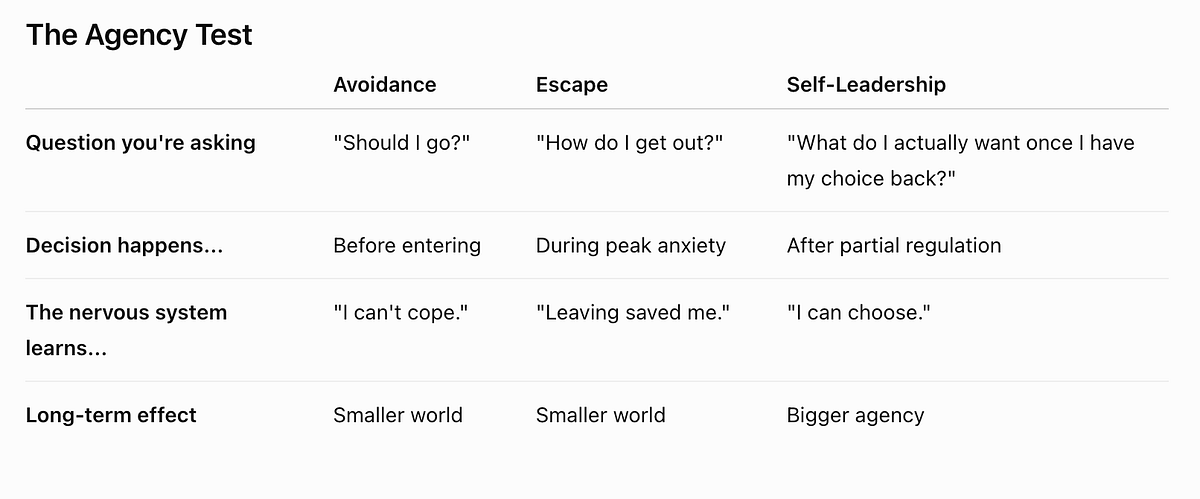
The Agency Test
Since that weekend, I’ve started asking myself one question whenever I feel an overwhelming urge to escape a situation.
Not:
“Should I stay?”
Not:
“Should I leave?”
Just this:
If I make this decision right now… who’s making it?
My values?
Or my nervous system?
I don’t always know the answer immediately.
Sometimes I still leave too early.
Sometimes I stay too long.
Recovery hasn’t made me perfect.
It’s made me more curious.
Instead of treating every anxious impulse as truth, I’ve learned to treat it as information.
That’s a very different relationship.
Because information doesn’t demand obedience.
It invites investigation.
Recovery Isn’t About Making Perfect Decisions
One concern people often have when they hear ideas like this is:
“What if I get it wrong?”
What if I stay when I should have left?
What if I leave when staying would have helped?
The honest answer is…
You will.
I certainly have.
I’ve left situations that probably would have become enjoyable if I’d given them another twenty minutes.
I’ve also stayed in situations long after my nervous system had stopped learning anything new, simply because I didn’t want to “fail” the exposure.
Neither taught me very much.
Recovery isn’t about becoming someone who always gets it right.
It’s about becoming someone who’s increasingly able to recognize which voice is speaking.
That’s a skill.
And like every skill, it develops through repetition rather than perfection.
Every experience becomes another piece of evidence.
Every trip.
Every dinner.
Every flight.
Every difficult conversation.
Your nervous system is always learning.
The only real question is:
What do you want it to learn?
Getting Your Choice Back
When I think back to that weekend, I don’t remember the campsite first.
I remember lying awake in my tent.
It was unbearably hot.
The music next door didn’t stop until almost four in the morning.
Mosquitoes were waiting every time I opened the tent.
I remember being convinced I’d made a mistake.
And I remember waking up the next morning expecting to feel exactly the same.
Instead, something surprising had happened.
The campsite hadn’t changed.
The weather hadn’t changed.
The memories attached to that place hadn’t changed.
I had.
Or more accurately…
The urgency had.
For the first time since arriving, I wasn’t trying to solve the weekend anymore.
I wasn’t trying to escape it either.
I simply had my choice back.
And I think that’s the feeling I’d been searching for all along.
Not confidence.
Not fearlessness.
Agency.
For years I thought recovery meant becoming someone who never wanted to leave.
Now I think recovery is something much quieter.
It’s becoming someone who no longer has to believe the first story their nervous system tells them.
It’s recognizing that urgency is a nervous system state — not necessarily a reliable source of truth.
It’s trusting that you don’t have to make permanent decisions from temporary physiological states.
You can wait.
You can become curious.
You can give your nervous system the chance to update its prediction.
And then…
You can ask the question again.
Maybe you’ll stay.
Maybe you’ll leave.
By then, the answer almost doesn’t matter.
Because the real victory isn’t staying.
The real victory is knowing the decision belongs to you.
That’s why I no longer think the most important question in anxiety recovery is:
“Should I stay or should I leave?”
I think it’s this:
Did anxiety make the decision before I did?
Because the moment the answer becomes “no”…
You already have something far more valuable than certainty.
You have your freedom back.
And in my experience, that’s what recovery has always been about.
Not staying.
Not leaving.
Getting your choice back.