Did Jocko Willink Accidentally Discover the Secret to Manifestation?
Answering “Good” to every setback sounds like pure stoic grit. Look closer and it runs on the same mechanism mystics have described for centuries.
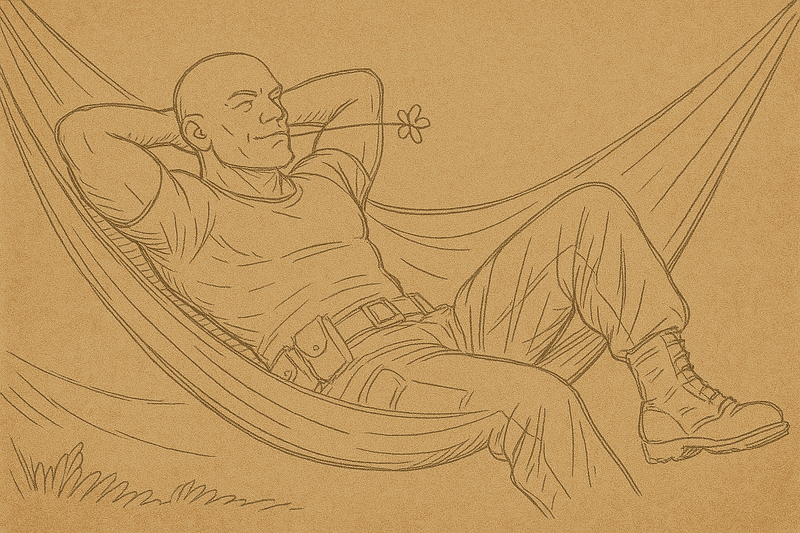
When Navy SEAL Jocko Willink tells his soldiers to answer “Good” to any form of adversity — lost mission, failed plan, broken gear — it sounds like stoic grit at its finest. But if you look deeper, you start to wonder: did Jocko stumble into the very same spiritual law that mystics and manifestors have been talking about for centuries?
“Good.”
A single word that reprograms your mind to find meaning in chaos.
A simple response that shifts your focus from resistance to possibility.
What Jocko does intuitively is the psychological equivalent of transmutation — turning lead into gold, pain into purpose, fear into focus. That’s not just mental toughness. That’s energetic alchemy.
The Hidden Mechanics Behind “Good”
Every time you respond “Good” to something that hurts, you are sending a signal to your subconscious that there is opportunity hidden in the obstacle.
You stop fighting reality and start collaborating with it. And that, right there, is the essence of manifestation.
Because manifestation isn’t about wishful thinking or staring at vision boards until reality bends. It’s about state management — maintaining coherence between your thoughts, emotions, and actions even when life presents contrast. The universe, or if you prefer, reality itself, constantly asks: “Are you sure you want this?”
The contrast — the delay, the failure, the pain — isn’t punishment. It’s feedback. It’s a stress test for your intention.
Depression, Anxiety, and the Art of Answering “Good”
When depression hits, the default answer is despair. When anxiety spikes, the mind screams for control. That’s the moment when Jocko’s “Good” philosophy becomes a spiritual discipline.
“Good — another training day.”
“Good — another chance to stay calm in the storm.”
“Good — now I get to see what I’m made of.”
To the rational mind this sounds insane. To the nervous system, it’s liberation. You’re no longer the hunted animal running from pain. You become the observer, the captain, the one who chooses the frame.
And the frame changes everything.
As I’ve written before, anxiety isn’t an external monster. It’s your soul pulling the handbrake, saying, “Wrong direction.” Depression isn’t the absence of life — it’s life refusing to move under the wrong conditions. When you meet that energy with resistance, it grows. When you meet it with curiosity — “Good, let’s see what this is teaching me” — it begins to transform.
The Science Catches Up
Neuroscience now shows that your thoughts and emotions don’t just interpret reality — they shape it. The brain’s default mode network, when stuck in loops of worry or self-pity, amplifies suffering. But the moment you shift into goal-oriented focus — the task-positive network — the chemistry changes.
By saying “Good,” you switch from survival mode to creation mode. You literally alter your neural firing patterns. You move energy from the amygdala to the prefrontal cortex — from fear to agency.
That’s not motivational fluff. That’s neuroplasticity at work.
From Victim to Creator
Every person who’s gone through hell knows this paradox: healing begins the moment you stop asking “Why me?” and start asking “What now?”
It’s what I learned when anxiety had me sleeping on my parents’ couch, unable to leave the house for days. The moment I stopped resisting the panic and started saying “Alright, let’s train with it,” something shifted. I was no longer drowning in the storm — I was learning to sail.
Jocko would call it discipline. Mystics would call it surrender. But both are pointing to the same law of reality: your attention is creative.
What you resist persists. What you embrace transforms.
Reality as Feedback Loop
You can look at reality as a static, external machine — or as an intelligent mirror responding to your state. When you answer adversity with “Good,” you are, in essence, instructing reality: “I’m ready. I can handle this.”
In quantum terms, you’re collapsing the wave function toward a version of reality where you grow. The same event that breaks one person becomes the awakening of another. The only difference is perception.
That’s why “Good” is more than stoicism. It’s manifestation in disguise. It aligns your inner frequency with the outcome you prefer. You’re not denying the pain — you’re integrating it into your power.
Training Day
The next time anxiety grips your chest, or depression whispers that you’re done, answer like Jocko:
“Good.”
Not sarcastically. Not in denial. But as a conscious act of creation.
Good — life is showing me my resistance.
Good — my nervous system is learning to regulate under stress.
Good — my soul is testing its own commitment to joy.
Each of those “Good”s is a command to the subconscious: keep going. Keep your eyes on the horizon. You are not here to escape contrast; you are here to master it.
Because in the end, manifestation is not about getting what you want — it’s about becoming who you need to be to hold it.
Jocko Willink may not use words like vibration or quantum alignment, but his “Good” philosophy touches the same truth that ancient mystics, modern neuroscientists, and trauma survivors converge on: reality is a training ground for consciousness.
When you meet it with openness instead of fear, you’re not just tough — you’re aligned.
You’re not escaping reality — you’re co-creating it.
So when life throws you another storm, smile like a mad monk and say:
“Good.”
Then get back to work — your inner work.