The In-Between Space: Where Your Inner World Shapes the Reality You See
What science can’t yet measure, and what your lived experience already knows.
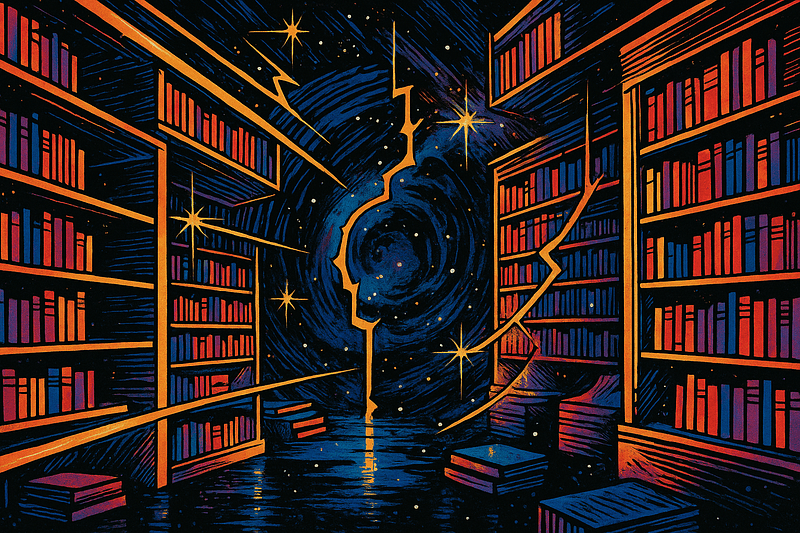
There is a territory most people never explore — a kind of twilight zone between what we can measure with instruments and what we feel in the quiet moments when the world gets still. It’s the space where the question “What if reality is partly a projection of your mind?” becomes less about bending atoms and more about understanding the way we participate in the world that unfolds in front of us.
This isn’t a place for certainty.
It’s a place for curiosity — the adjacent possible between psychology and physics, where inner life and outer world stop pretending to be separate categories.
I’ve spent years in that in-between.
Not because I sought it out, but because severe anxiety knocked me out of the familiar world and left me with nothing but raw perception, emotion, and the strange realization that the world changes dramatically when you change. The same street, the same café, the same person could feel threatening one month and grounding the next. Nothing external shifted, yet everything was different.
That kind of experience leaves an imprint.
It forces you to reconsider the line between what is “inside” you and what is “out there.”
The Universe According to Your Nervous System
If we approach the idea strictly through the lens of hard science, the notion that your mind directly “projects” reality doesn’t hold up. Physical matter doesn’t rearrange itself because you changed your belief system. The spin of electrons doesn’t accelerate when you’re stressed, nor do galaxies adjust their trajectory because you’ve had a moment of clarity. From the vantage point of today’s instruments, the external universe seems remarkably indifferent to the fluctuations happening inside a human mind.
And yet, what science cannot detect is often simply what our tools cannot yet measure. The absence of evidence is not evidence of absence. We know that perception is constructed, that attention shapes experience, and that long-term emotional patterns reorganize the nervous system in profound ways. What remains unclear is how far these internal reorganizations ripple into the world we inhabit over years, or even decades.
This is where things get interesting. People who undergo deep inner change often watch their outer lives reorganize in ways that feel almost improbable: relationships shift, opportunities emerge, patterns dissolve, meaning reorients itself, and sometimes even seemingly incurable disease goes into “spontaneous remission”. None of this proves that consciousness alters matter directly, but it does suggest that the boundary between inner transformation and outer consequence is porous, dynamic, and far from understood.
So while the universe may not obey your moment-to-moment moods, the life you experience — the version of reality that becomes available to you — may be shaped far more by your inner evolution than a mechanistic worldview can comfortably explain.
A Quiet Quantum Parable
It’s tempting to misuse quantum physics to justify spiritual claims, but we don’t need to. The real value lies in metaphor, not literal interpretation.
Wheeler’s delayed-choice experiment showed that the behavior of a particle depends on the type of measurement you perform — even if you choose the measurement after the particle should have already “decided” what it is. In a purely scientific sense, this says nothing about your personal reality. But as a metaphor for the psyche, it’s striking.
Your mind works in a similar way:
- before you choose, countless futures exist in the background,
- once you act, one of them becomes real for you,
- your focus determines which possibilities you can perceive,
- your emotional state determines which ones feel accessible,
- your beliefs determine which ones you allow yourself to pursue.
In this sense, you are not projecting physical reality; you are collapsing possibilities into lived experience. You are meeting the world through a particular lens, and that lens determines the version of reality you can interact with.
Fear narrows the world.
Curiosity expands it.
Love rewrites its contours entirely.
The world doesn’t change.
Your access to it does.
The Canvas and the Colors
The external world may be the canvas, but your inner world determines the colors you see.
Thoughts give shape.
Emotions give tone.
Beliefs give texture.
Memory gives depth.
Nervous system regulation controls the clarity of the entire scene.
When you are anxious, the world becomes sharper, darker, and more fragmented. Neutral expressions look threatening. Ordinary moments feel heavy. Time distorts. Your sense of possibility constricts.
When you are regulated and connected, the same world feels open, warm, and spacious. The mundane becomes meaningful. Relationships deepen. Decisions expand instead of collapse.
Physically, nothing changed.
Perceptually, everything did.
And since you only ever live inside perception, that shift becomes the difference between suffering and freedom. It was only toward the end of my journey that I began to understand this on a deeper, somatic level. I would feel my body moving into total panic and constriction, while another part of me — the observer — quietly asked, “What if I can turn this energy around? What if I can change my perception to love? What if shifting my focus to the good things I can sense in my immediate environment right now could help me change my state?”
I started paying attention to the shimmering leaves on the trees, the sun and the clouds in the sky, and the subtle sense of peace that emerges when you orient yourself toward what is good, even if it’s just in this one moment.
The Middle Truth Is Where Transformation Happens
Most people treat inner and outer reality as separate domains. Either the world shapes you, or you shape the world. But the truth seems to be something more intertwined and far more interesting.
The world doesn’t rearrange itself in response to your passing thoughts. But your thoughts, emotions, and beliefs reorganize you, and you are the instrument through which reality is interpreted, acted upon, and ultimately experienced.
This is why inner change ripples outward in ways that look, from the outside, like life itself is responding.
Not instantly.
Not magically.
But steadily, through the long-term interplay of attention, behavior, relationships, and meaning.
You’re not bending the universe.
You’re bending the lens through which you navigate it — and that makes all the difference.
What If This Is the Real Frontier?
What if the next evolution of human understanding isn’t about proving that consciousness creates matter, but understanding how consciousness shapes the version of reality we participate in?
What if your inner work isn’t a private psychological exercise, but the mechanism through which new worlds become possible for you?
What if healing doesn’t change the universe, but changes your ability to perceive the parts of it that were hidden behind fear?
And what if the universe, in its own quiet way, doesn’t meet you with certainty, but with possibility — waiting to see who you become before it reveals what comes next?
That is the in-between space.
The adjacent possible.
The place where science ends, lived experience begins, and the future — inner and outer — starts to unfold.