Anxiety is not just “In your head”: How the Body’s Biochemistry Fuels the Anxiety Cycle
Anxiety isn't only in your head: how the HPA axis, gut-brain connection, inflammation, and histamine keep the cycle running — and how to calm it.
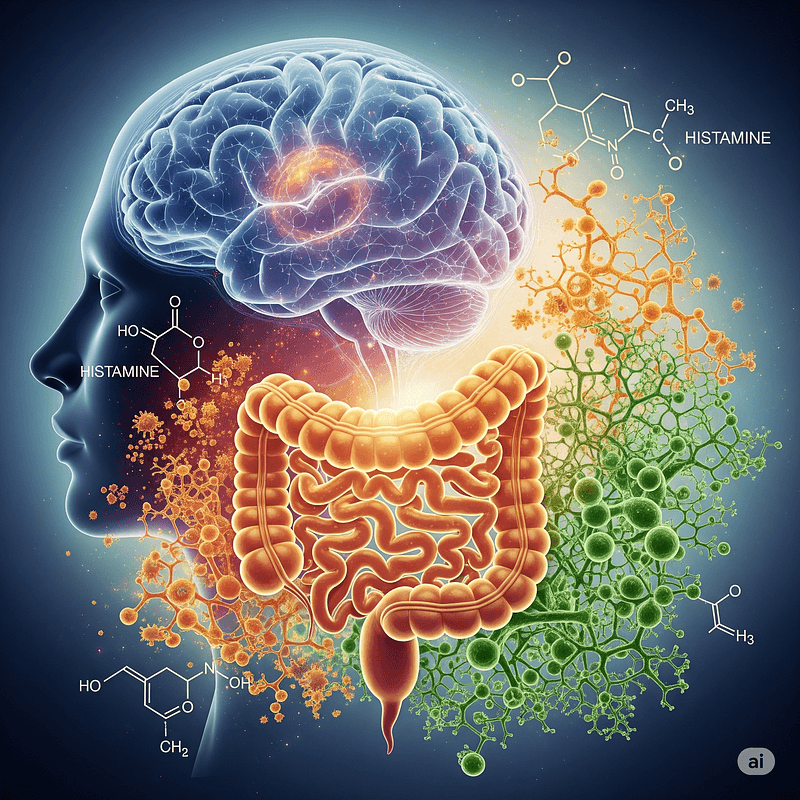
Created with Gemini
For too long, anxiety has been predominantly viewed as a purely psychological phenomenon, something “all in your head.” While thoughts, perceptions, and past experiences undoubtedly play a crucial role, this narrow perspective overlooks a critical truth: anxiety is deeply rooted in a dynamic, feed-forward cycle between the body and the mind.
Far from being separate entities, our physiological state profoundly influences our mental landscape, capable of amplifying negative thinking patterns and emotions. Understanding the biochemistry of anxiety reveals that healing the body can be a powerful amplifier for mental well-being.
The Body’s Silent Orchestra: Beyond Brain Chemicals
While neurotransmitters like serotonin and dopamine in the brain are well-known players in mood, the body’s influence on anxiety extends far beyond the skull.
- The Stress Response System (HPA Axis): When faced with perceived threats, our hypothalamic-pituitary-adrenal (HPA) axis springs into action, releasing stress hormones like cortisol and adrenaline. While essential for acute survival, chronic activation leads to persistent physiological arousal: a racing heart, shallow breathing, muscle tension. These bodily sensations, in turn, signal “danger” back to the brain, perpetuating the anxious state.
- The Gut-Brain Axis: Our gut, often called the “second brain,” houses trillions of microbes (the microbiome) that produce neurotransmitters, regulate inflammation, and influence nutrient absorption. A dysbiotic (unbalanced) gut can lead to inflammation and altered production of mood-regulating compounds, sending distress signals to the brain and contributing to anxiety, brain fog, and irritability.
- The Immune System and Inflammation: Chronic inflammation, a low-grade immune response, is increasingly linked to mental health disorders. Inflammatory molecules (cytokines) produced by immune cells can cross the blood-brain barrier, altering brain function, neurotransmitter balance, and neuronal plasticity, directly contributing to feelings of anxiety, fatigue, and anhedonia.
The Biochemical Amplifier: Histamine and Mast Cell Activation
A particularly potent player in the body-mind anxiety loop is histamine, a chemical often associated with allergies, but with far-reaching effects.
For years, I personally grappled with the aftermath of a particularly intense mushroom trip. What began as a recreational experience quickly spiraled into a nightmare, leaving me with profound and persistent anxiety and panic attacks. It felt like a psychological scar, a “horror trip” that kept replaying. It was only much later, through the guidance of a specialist in integrative medicine, that I began to understand the true culprit: histamine.
I learned that certain mushrooms can actually trigger a histamine response in sensitive individuals. What I experienced was likely not just a “bad trip” in the conventional sense, but a massive allergic shock overlaid with a monumental panic attack, fueled by an overwhelmed physiological system. This realization was groundbreaking.
My specialist diagnosed me with an inflamed gut and Mast Cell Activation Syndrome (MCAS), conditions that rendered me highly sensitive to histamine. This explained why, even long after the initial trauma, whenever I “stacked up” too much histamine — be it from certain foods, stress, or environmental triggers — I would experience debilitating “flashbacks” of that terrifying state, vivid anxiety surges that felt uncannily similar to the initial experience.
This personal journey vividly illustrates how histamine, a chemical often associated with allergies, can act as a neurotransmitter in the brain, regulating wakefulness, attention, and cognitive function. However, when histamine levels are elevated or when the body’s “alarm cells” — mast cells — become overactive, the impact on anxiety can be profound.
Mast Cell Activation Syndrome (MCAS) is a chronic, multi-systemic disorder where mast cells inappropriately release an array of potent chemical mediators, including histamine, tryptase, leukotrienes, and prostaglandins, affecting virtually every body system. For individuals with MCAS, or even those with chronic histamine intolerance, the experience of anxiety can be dramatically amplified:
- Mimicking Panic Attacks: As my story highlights, the physical symptoms of histamine excess — such as rapid heart rate, flushing, dizziness, shortness of breath, and a sudden drop in blood pressure — strikingly mimic the core sensations of a panic attack. This means a biochemical event can directly feel like a psychological crisis, even without an immediate mental trigger.
- Heightened Neuronal Excitability: Histamine, particularly through its H1 and H2 receptors, is known to increase the excitability of neurons in various brain regions. This translates to a nervous system that is more “on edge,” more prone to firing, and more sensitive to all forms of input.
- The “Palpability” of Thoughts and Sensations: This is where the theory of histamine “dialing up the sensitivity of the body, making every sensation, including thoughts and the feeling of anxiety, way more palpable” becomes evident. If histamine increases overall neuronal sensitivity, it can make every internal and external sensation more vivid, more intense, more “palpable.”
- Sensory Amplification: A slight noise might feel jarring, a light touch might feel overwhelming, and an underlying bodily sensation (like a normal heart beat) can feel like a pounding drum. This increased sensitivity can be profoundly disorienting.
- Interoceptive Overload: Interoception, the awareness of our internal bodily states, becomes hyper-attuned. This means the subtle hum of bodily processes is amplified, leading to a heightened, often uncomfortable, awareness of physiological functions that might otherwise go unnoticed.
- Racing Thoughts as Amplified Cognition: When the brain’s neurons are operating at a higher state of excitability, thoughts themselves can become more rapid, intrusive, and intense, creating the experience of “racing thoughts.” It’s not just the content of the thoughts, but their sheer speed and overwhelming presence that becomes more palpable due to biochemical upregulation. For me, this explained the “flashbacks” — my body was recreating the physiological state of panic, which then triggered the associated mental terror.
- Neuroinflammation and Sensitization: Beyond histamine, other mast cell mediators can induce neuroinflammation and cause long-lasting changes in neuronal excitability and synaptic communication. This chronic sensitization creates a nervous system primed for anxiety, where the threshold for feeling overwhelmed or panicked is significantly lowered.
The Feed-Forward Cycle: When Body and Mind Collude
This biochemical sensitivity creates a powerful feed-forward loop:
- Physical Symptoms Trigger Mental Distress: Elevated histamine or mast cell activation generates unsettling physical sensations (e.g., racing heart, shortness of breath, as I experienced during my “flashbacks”).
- Mind Interprets Physical as Threat: The brain, attempting to make sense of these intense bodily signals, interprets them as signs of danger or impending doom, triggering fear and more anxiety.
- Anxiety Worsens Physical State: The mental anxiety response (stress hormones, sympathetic nervous system activation) can, in turn, further activate mast cells, disrupt gut function, and increase inflammation, creating more physical symptoms.
- Vicious Cycle: This continuous loop keeps both the body and mind trapped in a state of heightened alert, making it incredibly difficult to break free from negative thought patterns and emotional distress. It explains why someone might feel intensely anxious even when “there’s nothing to be anxious about” — their body is sending powerful signals, as my system did, recreating the memory of trauma through a biochemical pathway.
Breaking the Cycle: Healing the Body to Liberate the Mind
Recognizing this biochemical amplifier is crucial because it offers new avenues for intervention. While psychological therapy remains invaluable for addressing thought patterns and coping mechanisms, integrating somatic and biochemical approaches can provide a powerful foundation for mental well-being. By “fixing the body,” we don’t bypass psychological work; we amplify its effectiveness.
For me, understanding and addressing my inflamed gut and MCAS with the help of an integrative medicine specialist was a turning point. It wasn’t about ignoring my psychological trauma, but about creating a physiological state where healing was actually possible.
Strategies that address the body’s biochemistry can include:
- Dietary Interventions: For individuals with histamine intolerance or MCAS, a low-histamine diet can significantly reduce the body’s overall histamine load, calming systemic symptoms and, consequently, anxiety levels. Gut-healing protocols can restore microbiome balance, reducing inflammation and supporting neurotransmitter production.
- Targeted Medications and Supplements: Antihistamines (H1 and H2 blockers) and mast cell stabilizers (like Ketotifen or Cromolyn sodium) can directly mitigate the effects of histamine and prevent mast cell degranulation, leading to noticeable reductions in physical and psychological symptoms, including anxiety and brain fog.
- Lifestyle Adjustments: Stress management techniques like mindfulness, deep breathing exercises, and gentle movement (e.g., yoga, walking) don’t just “relax the mind”; they actively modulate the HPA axis, reduce inflammation, and can stabilize mast cells, thereby calming the entire physiological system.
When the body is no longer sending constant “danger” signals, and its internal landscape is calmer, the mind becomes more receptive to psychological interventions. It’s easier to challenge negative thoughts, regulate emotions, and engage in therapeutic work when the underlying physiological distress is reduced. My own experience showed me that by calming the biochemical storm, the psychological “flashbacks” lost their intensity and eventually faded.
Anxiety is never “just in your mind.” It’s a complex interplay where thoughts shape the body, and the body, through its intricate biochemistry, powerfully shapes the mind. Embracing a holistic approach that nurtures both our psychological and physiological well-being offers the most comprehensive path to breaking the anxiety cycle and fostering true mental resilience.