Anxiety Had Me in a Chokehold Until I Learned This One Sentence
Catastrophic thoughts aren't insight — they're your brain explaining a body in alarm. The neuroscience that finally loosened anxiety's grip on me.
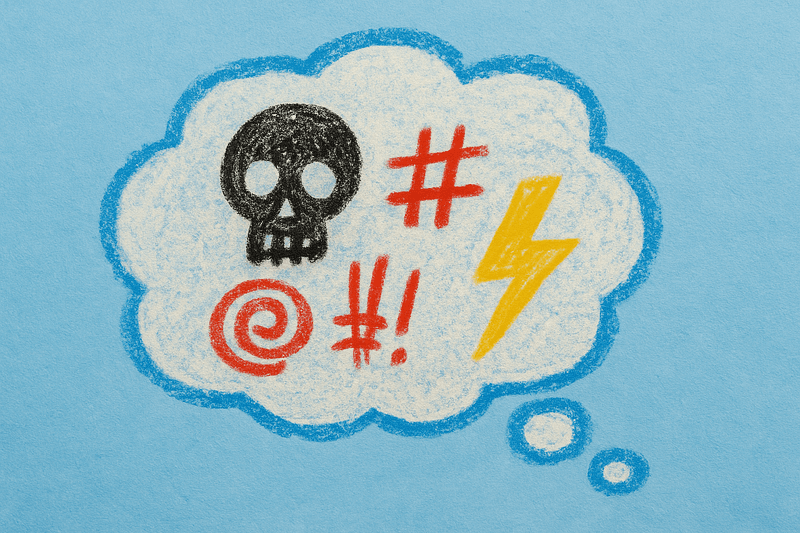
For most of my life, anxiety felt like something that seized me from the inside: a sudden jolt in the chest, a rush of heat in my arms, a tightening across the ribs, and then the mind instantly supplying the darkest possible interpretation. It took me years to understand that this pattern wasn’t a character flaw or a failure of willpower. It was physiology doing what physiology does. And ironically, the harder I fought it, the more entrenched it became.
For a long time, I tried healing anxiety by going after the biology directly. I experimented with supplements, histamine protocols, nervous system hacks, gut repair strategies, an alphabet of vitamins, and every trick the internet had to offer. Some things helped a little, others made me worse, but none of them touched the core problem: my relationship to my thoughts.
The shift began when I started learning what actually happens in the brain during a spike of anxiety. When the amygdala perceives a possible threat, even a faint one, it sends a rapid signal through the hypothalamus. Within milliseconds, the sympathetic nervous system fires: heart rate increases, blood vessels constrict, and the adrenal glands release norepinephrine. Your body becomes a warning siren in motion.
But here’s the part that changed everything for me:
the brain then tries to make sense of those bodily sensations by creating thoughts that match the level of activation.
This is called interoceptive prediction. When your internal state feels like an emergency, your mind invents the story of an emergency.
Catastrophic thoughts aren’t insight.
They’re the brain’s attempt to explain the physiology of alarm.
This understanding eventually led me to a simple sentence that changed far more than I expected:
“I don’t need to think these thoughts.”
At the beginning, the sentence felt almost laughable. When your system is flooded with adrenaline and cortisol, the thoughts that arise feel fused to your identity. They seem inevitable. But that’s because, neurologically, they are: the prefrontal cortex — the part of the brain responsible for reasoning and perspective-taking — goes partially offline in states of high arousal. In that moment, believing your thoughts isn’t a choice. It’s a reflex.
Once I understood the circuitry behind this, the sentence stopped feeling like denial. It became a reminder that the thoughts were a physiological echo, not a message. The biology created the storm; my mind was just trying to interpret it.
I began repeating the sentence whenever a spiral started. Not as a way to suppress anything, but as a way to create even a small gap between sensation and story. That small gap eventually became the beginning of self-regulation.
This is where the nervous system comes in. The brain learns primarily through prediction error. Each time you experience a surge of anxiety and do not treat it as danger, you are sending the amygdala new information:
“This feels loud, but it is not a threat.”
Over time, those micro-corrections weaken the old pathways and strengthen the prefrontal cortex’s capacity to stay online.
Letting go of anxious thoughts is not about forcing the mind into silence.
It’s about retraining the system that produces those thoughts in the first place.
As I practiced this, I also started replacing the catastrophizing with slightly more hopeful interpretations. Not affirmations, not forced positivity, just small pieces of evidence that things might not be as hopeless as my body insisted they were. And because anxiety distorts your ability to perceive progress, I often asked friends or relatives to reflect back what they were noticing. Their perspectives loosened knots that I couldn’t untie on my own. From a neuroscientific perspective, this makes sense: co-regulation is a core part of how humans calm their nervous systems. The social brain is a real system, and it plays a real role.
Of course, setbacks were part of the process. Anxiety recovery is rarely linear. On difficult days, the whole system slid back into old patterns, and the thoughts gained their old sharpness. But each time, the same principle applied:
the thoughts were symptoms, not truths.
That distinction alone kept me from being swallowed by every spiral.
Little by little, something shifted. The thoughts still came, but they didn’t grip me. The sensations still rose, but they felt less like emergencies. My nervous system was slowly learning safety again through lived experience, not through intellectual understanding. And once the overall arousal level dropped, my physiology changed too: fewer mast cell flares, better histamine tolerance, calmer digestion, less systemic reactivity. The biology followed the nervous system, not the other way around.
And eventually, I noticed something surprising. Not dramatic, not sudden — just a quiet awareness that the inner world no longer felt hostile. I wasn’t cured. I wasn’t fearless. But I was no longer trapped inside the machinery of my own alarm system. I could feel anxious without believing that anxiety meant anything about my future.
As the months passed, the thoughts arrived like weather rather than warnings. My internal landscape stopped feeling like a battlefield and started feeling more like a place I could inhabit again. Not perfectly, but honestly. Not free of anxiety, but free of the belief that anxiety defined me.
And this is where the ending becomes important.
Because over time, something softens. Not through force, but through familiarity. The thoughts come and go, the body rises and falls, and the mind learns that it no longer needs to attach a story to every sensation. You start to sense that beneath the noise there is a steadiness that was there the whole time, waiting for you to reclaim it.
You realise that what once felt like danger was often nothing more than your body asking to be understood. And once the body feels understood, it stops shouting. It stops sounding the alarm at every shift in the wind. It returns to something quieter, something more human, something that feels like coming home.
And at that point, the sentence that seemed so small in the beginning becomes something your whole being believes:
I don’t need to think these thoughts.
It becomes a truth rather than a technique.
A knowing instead of a coping strategy.
A doorway back to yourself, one gentle repetition at a time.