How to change your toxic thinking
Using your mind to put a leash on your brain

Photo by Anthony Tori on Unsplash
I am grateful for the biggest crisis in my life. Severe anxiety showed me how little we get taught about how to use our mind (not brain) properly. Growing up in western society you never get taught how to deal with automatic negative thinking patterns and intense emotions. It’s quite the opposite. You get a label like “depressed” or “generalized anxiety” and off you go into the nothingness of suppressed emotions, supported by an artillery of drugs, delivered by a system that is not designed to get to the root cause. If you want to get out of the darkness, there’s only one person who can help you. You.
Our mind is an efficiency-seeking machine, always on the lookout for patterns and commonalities, it can form into habits. It is built to survive and make quick decisions based on experience and a “best guess”. Being happy is not a priority. And so it makes sense that the system for worrying, anticipating, and scanning for threats is our so-called “default mode network”. Negative events outweigh positive events in importance like 3 to 1. Meaning for every negative thought, you need 3 positive thoughts to balance it out. Listen to the news once per day and the game is lost already.
The other thing your mind loves to do is solving problems or working on things that are challenging enough, but not too challenging. The task-positive network, as the name suggests, is a neural network that is active when you are engaged in goal-oriented activities. During times of crisis, the balance between the default mode network and its counterpart the task-positive network can get out of whack. Increased functional connectivity in the default mode network is associated with both anxiety and depression. This will be amplified if you are a highly distracted person. The analytical part of your brain is not able to focus on more than one thing at a time. Multi-tasking is a myth. What you are doing is switching between tasks and that’s as bad as mindlessly scrolling through your Insta feed or hopping from one YouTube video to the next. That way you are teaching your brain to behave the exact opposite of what it is made for.
You believe that you have free will when your way of thinking is actually a collection of habits. 60 to 70 thousand thoughts are running through our heads every day and if you don’t give them direction, they will keep you in the same old loop they always have and make you your slave without you even noticing. At age 35 most people don’t change anymore and that’s because change is “dangerous”. You just don’t leave the cave when you’re not hungry. It’s a protection mechanism that we need to be aware of. It is trying to keep us safe, in a world that couldn’t be safer. Anytime you try to do things differently, you will encounter inner resistance. That’s why changing your thinking (or anything else) is so hard. Your mind’s default operating mode says “What’s normal is what’s right for you” and it will fight with you to protect it, even if that way of thinking is creating a lot of pain and suffering in your life. It is just doing what it was told to do.
Waking up
Awareness is key, but toxic without action. If you have never set a foot on the path of self-knowledge, it can be scary to sit still and observe your thoughts. Thoughts trigger emotions and emotions trigger more thoughts. If you don’t know how to manage that cycle of doom, and you are not willing to put in the work, you better keep distracting yourself.
At some point, I was not able to work on meaningless freelance projects anymore, because I had built the belief that I can only work on things that are meaningful (like writing this article). The problem was that I needed freelance gigs to make money. It was so bad that I would get automatic negative thoughts and panic attacks during video calls. There are a lot of techniques out there that help you reprogram your automated beliefs, but the work of Dr. Caroline Leaf worked wonders for me. I followed her simple and very rational 5 step process and after 3 weeks I started seeing differences in my automatic thought patterns. Whenever I felt stressed from meaningless work, my mind would automatically bring up my reframed thought pattern instead of the old toxic perspective.
One thing that she’s recommending before you even start the process, is brain building. Sounds fancy, but is nothing else but deep and deliberate learning. That’s what your brain loves. Focussed work on a single topic that requires deeper levels of understanding and analysis. You could call it another distraction because it sounds like an escape from heavy emotions and irrational thoughts, but it is not. It is a tool for you to teach your brain to rebalance the default mode and the task-positive network. And that is what you need to work on your thoughts and emotions before anything else. Read a book or watch a movie and try to really understand it. Take notes and involve as many senses as possible to increase the amount of new neural connections.
The 5 steps
Once you know how to get your brain into a calm and focused state, you can start working on the toxic thoughts. The process always starts with observing your thoughts. You identify the ones that are stressing you the most, write them down in a list and pick the one that is creating the strongest inner turmoil or resistance when you think about it. When you lift these thoughts from the subconscious, you are already in the process of changing them, since you are questioning the automated thought by pulling it up and looking at it.
As you know now, your brain loves working on problems and it loves deep analytical work. Looking at that thought pattern and asking yourself if that thought is actually useful, will already get you into the problem-solving mode. In the 2nd step, you start asking questions from different angles to shed light on the issue. Why are you thinking this? Who’s part of this thought? When did you think that way for the first time? How is this thought connected to my emotional state? What situations are triggering that pattern?
In the 3rd step, you start to write down what you have learned in step 2. You can either write it down the way you would write it into your journal or use a more brain-friendly approach like a mindmap. Dr. Leaf is using an approach called the “metacog”. It is a mindmap-like approach to help curb metacognition (thinking about thinking). You write down the toxic thought, circle it, and then use a branch-like structure to answer the questions with single words or short sentences. Your brain is thinking in images and associations. It doesn’t need full sentences to make sense of something. This approach is a lot faster than writing and a lot more comprehensible and effective for our monkey minds.
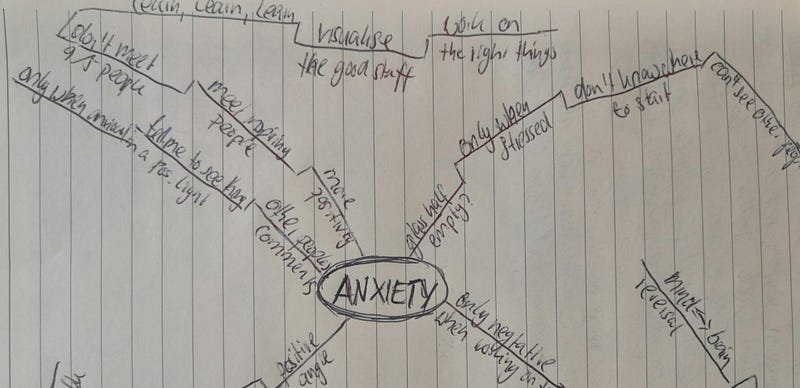
The whole process is actually based on the way our brain is learning new things. The 4th step is deepening our understanding from steps 2 and 3. In this step, you are reviewing your notes, marking the important parts, or even add here and there if you forgot to do that in step 3.
The 5th step is about reframing your toxic thought. You now know why that thought is wreaking havoc on your life and there might be a new way of seeing things. Going back to my “I can’t do meaningless work for the sake of making money anymore”-thought, I can say that this is still something I am feeling, but I took the sting out of it by reconceptualizing it. My new thought was “Whenever I am feeling anxious or stressed by meaningless work, I am reminded to keep on working faithfully and motivated on meaningful work (like writing this article). It is ok to do this work, it is earning me the money I need right now”.
Spaced repetition will help you to install that new thought over the long term. In the first 3 weeks, you are doing the 5 steps and set a reminder on your phone, write post-its and stick them to your door, computer, or whatever. You must repeat that thought several times per day. The whole process takes 9 weeks. In weeks 4 to 9 you are simply repeating that thought without doing the 5 steps beforehand. That’s like 2 to 5 minutes of work every day and after 9 weeks the neural connections for that new thought pattern have deepened and will fire whenever the old pattern would have triggered.
One day at a time
I know that it sounds too simple to be true and might even sound like quack science to you, but think about it: How do you learn new information? How is this different from building thoughts and beliefs? Just because you didn’t actively choose to believe that thought doesn’t mean you haven’t accepted it at some point. We need to learn how to use our minds and brains properly. We know how to eat right and train our bodies, but we haven’t mastered our most powerful tool. Instead, we let the outside world determine our state of being and feel like we are slaves to our thoughts and emotions. We need to learn how to put a leash on our thinking and make our minds the masters of our inner world again. It needs a lot of time and practice to do that. The thoughts, beliefs, and concepts in our subconscious minds have grown for decades. They won’t disappear with a pill or a meditation session once a week. It needs deliberate work, patience, dedication, and perseverance to do that. The process itself will teach you tons of things about yourself and, if you follow through, give you the most powerful tool one can possess. A directed mind.