The Two Forces That Can Build Both Anxiety and Freedom
Anxiety isn't a weak mind — it's a powerful one captured by threat. How focus and belief build your inner reality, and how to reclaim them for freedom.
ChatGPT
What if anxiety is not evidence of a weak mind, but of a powerful one that has never learned how to wield its own capacities?
I have been thinking about this question a lot lately because, when I look back at my own years with anxiety, I no longer see only dysfunction. I also see an astonishing demonstration of psychological force. My mind could take a single sensation in my body and build an entire reality around it. A skipped heartbeat could become evidence of danger; a strange feeling of unreality could make me question my sanity; an intrusive thought could capture my attention for days, even when another part of me knew perfectly well that it was irrational. One frightening possibility could somehow acquire more emotional weight than a thousand pieces of evidence against it.
At the time, this felt like powerlessness. In retrospect, I am not so sure. The suffering was real, often devastatingly so, but beneath it were two capacities that shape far more of human experience than we usually acknowledge: focus and belief.
An anxious mind can be an extraordinary focusing machine. It can enter a room full of safety and find the one thing that might be dangerous. It can inhabit a healthy body and detect the smallest irregularity. It can move through a loving relationship while becoming preoccupied with one ambiguous facial expression, one delayed message, one subtle change in tone. Out of a hundred possible futures, it identifies the most frightening one and then returns to it again and again, examining it from every angle until a possibility begins to feel like an approaching reality.
This is not a lack of mental power. It is mental power captured by threat.
The mechanism becomes especially potent because focus rarely operates alone. What we repeatedly attend to begins to acquire significance, and what acquires significance becomes easier to believe. Once belief enters the loop, perception itself starts to change. We notice more evidence for what we already fear, remember experiences that support the emerging story, interpret ambiguity through its lens and behave in ways that make the threat feel increasingly real. The person who fears illness begins monitoring the body more closely and therefore notices more sensations. The person who fears rejection becomes more attentive to subtle signs of distance and therefore encounters more apparent evidence of rejection. The person who fears losing control starts checking whether they still feel in control, and the act of checking makes every fluctuation in consciousness more salient.
Focus says, “Look here.” Belief says, “This matters.” Together, they can gradually construct a world.
This is one of the most humbling things anxiety ever taught me. A human being can suffer immensely from something that is not happening in the present moment and may never happen at all. The feared catastrophe can exist primarily as an anticipated future, yet the body mobilizes as if it were already here. The mind imagines, the nervous system responds, attention narrows, behavior changes and life reorganizes itself around an event that has not occurred. We usually describe this only as dysfunction, and clinically that may be appropriate, but I think there is another way of looking at it as well. Anxiety reveals just how profoundly imagination, attention and belief can shape lived experience.
Now place that mind inside the modern world.
We live in an environment that competes relentlessly for attention, and much of that competition is won through fear, outrage, inadequacy and comparison. Algorithms learn what disturbs us because disturbance keeps us engaged. News cycles privilege threat because threat captures attention. Advertising has spent generations perfecting the art of making people feel incomplete before offering them a solution. Social media gives us an effectively infinite number of people against whom we can measure our bodies, careers, relationships, homes, lifestyles and progress.
The message is rarely stated directly, but it is everywhere: you are not yet enough.
You should be more successful, more attractive, more productive, more confident, more healed, more optimized, more disciplined, more spiritual, more adventurous and more certain about where your life is going. You should have processed your childhood by now. You should know your purpose. You should build a business, travel the world, regulate your nervous system, find the perfect partner, maintain an impressive body and somehow remain effortlessly present while doing all of it. Even healing itself can become another arena of inadequacy, another identity project in which the person is constantly monitoring whether they have finally become the version of themselves they believe they should be.
I sometimes wonder whether anxiety is, at least in some cases, what happens when an immensely sensitive and adaptive human system is placed inside this environment without ever being taught how to consciously direct attention or examine belief. We learn mathematics, language and professional skills, but few of us are taught how to relate to the machinery through which we experience reality. We are rarely taught that attention can be trained, that repetition can masquerade as truth, that a thought does not deserve obedience simply because it appears with urgency, or that many of the beliefs organizing our lives were absorbed long before we were capable of consciously choosing them.
Instead, we inherit a mind, fill it with the expectations of family, culture, school, work, advertising and social comparison, expose it to thousands of daily triggers, and then wonder why it sometimes turns against us.
This is where I find the spiritual interpretation of anxiety interesting, although I want to be careful not to romanticize suffering or pretend that every anxiety disorder contains a hidden mystical message. Anxiety can emerge through trauma, conditioning, chronic stress, sensitization, biology, avoidance learning and countless interactions between them. Sometimes a sensitized nervous system is simply a sensitized nervous system, and telling a suffering person that their anxiety is “their soul speaking” can become another burden, another mystery they are expected to solve.
Yet I also think something important is lost when anxiety is understood only as malfunction. There are moments when anxiety seems to arise in the friction between the life we are living and the life that feels true to us; between who we are and who we believe we must be; between what we genuinely want and what we think we are allowed to want. A person can spend years becoming extraordinarily skilled at meeting expectations while gradually losing contact with the part of themselves that could tell them whether those expectations were ever theirs.
Perhaps this is one reason anxiety so often becomes entangled with control. When we lose a felt sense of inner direction, we compensate by trying to manage the outer world. We analyze more, predict more, prepare more and attempt to eliminate uncertainty. We become hyper-attuned to other people’s reactions because their approval has become part of our navigation system. We ask whether we are doing life correctly rather than whether we are actually living it. The further we move from ourselves, the more desperately we may try to secure ourselves through certainty.
In that sense, anxiety can sometimes be understood as friction. Not a divine oracle and not an infallible message, but the friction produced by a system that can no longer move smoothly within the structure it has built. The body tightens, the mind accelerates and something in us begins searching for escape. Yet because most of us were never taught to ask where we might be abandoning ourselves, we ask a different question: what is wrong with me?
That question can begin another cycle. We focus on the anxiety, study the anxiety, monitor the anxiety and organize our lives around preventing the anxiety. We search for the perfect explanation, the hidden deficiency, the unresolved trauma, the missing supplement, the hormonal imbalance, the psychological technique that will finally remove the problem. Some investigation is sensible and necessary, of course, but there is a point at which the search itself becomes an expression of the same mechanism. Our focus remains captured by threat, and our behavior continues to communicate that something must be terribly wrong.
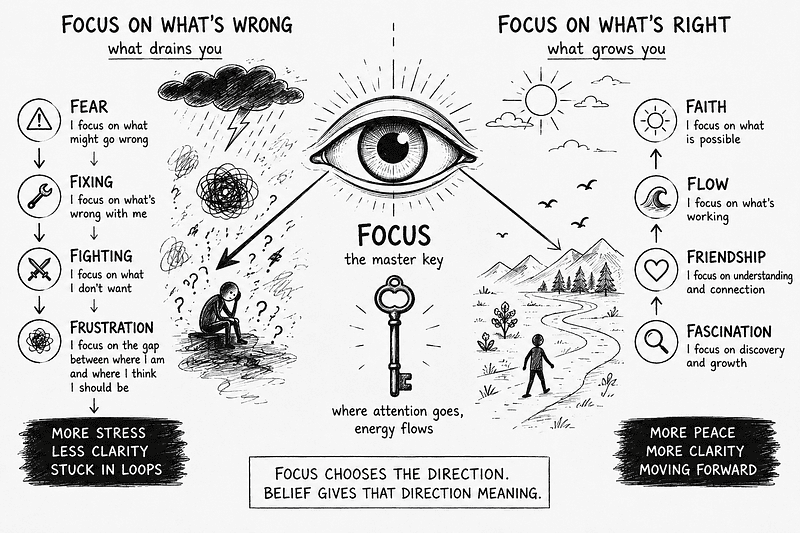
This is why I have started to think of focus as a kind of master key. Fear, fixing, fighting and frustration often appear to be separate reactions, but all of them can be intensified by where attention repeatedly goes. Focus on what might happen and fear grows. Focus on what seems wrong and fixing begins. Focus on what should not be there and the mind starts fighting. Focus on the distance between where you are and where you believe you should be, and frustration becomes almost inevitable.
The loop then reinforces itself. Fear searches for more danger. Fixing discovers more problems. Fighting increases sensitivity to whatever is being resisted. Frustration produces constant measurement of whether progress is finally happening. The mind keeps finding evidence because it has been trained where to look.
But if focus is the master key, then the same capacity that helps lock the door may also help open it.
This does not mean forcing yourself to think positively. It does not mean denying pain, pretending danger never exists or repeating affirmations while secretly trying to suppress fear. That would simply be another form of struggle. I mean something quieter and more disciplined: learning to notice what receives your attention, recognizing that not every thought deserves further investment, allowing sensations to exist without immediately turning them into stories, and understanding that uncertainty does not always require resolution.
It means learning to return attention to the life that is actually happening. To the conversation in front of you, the work that matters to you, the person you love, the music you are hearing, the body moving through space, the thing you are creating, the small impulse of curiosity that would otherwise be drowned out by the demand to figure everything out. Over time, this may be one of the deepest forms of recovery: not merely reducing anxiety, but making life larger than the problem around which attention once revolved.
Belief matters just as much, because attention alone does not determine our world. We are also constantly assigning meaning to what we notice. A racing heart can mean danger or exertion. Uncertainty can mean impending catastrophe or simply the absence of information. A difficult emotion can mean regression or a normal movement of human experience. A setback can mean that nothing has worked or that a nervous system is still learning. The event matters, but the meaning attached to it often determines what happens next.
This is where I believe anxiety reveals something profound about human potential. The same mind that can construct a terrifying future in extraordinary detail can imagine a life that does not yet exist. The same capacity for belief that can make catastrophe feel inevitable can support conviction, self-trust and perseverance. The same sensitivity that becomes hypervigilance can become empathy, perception and creative depth. The same pattern-recognition system that finds danger everywhere can notice opportunities, connections and possibilities that others miss.
These capacities are not inherently pathological. They are powerful. The question is whether we learn to wield them.
A sword is neither good nor bad because of its sharpness. Its power depends on the hand that holds it. Focus can become rumination, but it can also become devotion. Belief can become catastrophic certainty, but it can also become the willingness to move toward a future before there is proof that it will work. Imagination can rehearse disaster, but every work of art, every company, every journey and every meaningful change in a human life also began as something that did not yet exist. Sensitivity can make the world overwhelming, but it can also make the world extraordinarily rich.
Perhaps this is why I no longer see my own history with anxiety only as a story of what went wrong. I increasingly see it as a story of power without leadership: a mind with enormous imaginative capacity, a nervous system trying desperately to protect me, attention captured by threat and belief fused with fear. I spent years trying to become less anxious without understanding that I might also need to become more conscious of the forces through which anxiety was shaping my reality.
Recovery, from this perspective, is not about becoming less powerful. It is about learning to hold the sword.
It is the gradual practice of reclaiming attention from every voice that profits from insecurity. It is questioning beliefs that were inherited rather than chosen. It is learning that repetition is not truth and urgency is not authority. It is noticing when the life you are building is organized around avoiding fear rather than moving toward what matters. It is allowing emotion without surrendering choice, hearing fear without automatically obeying it, and becoming increasingly willing to disappoint the expectations that require you to abandon yourself.
Perhaps anxiety really does sit at one end of a spectrum of human psychological potential. At that end we see the devastating force of an untrained mind in a world full of negative triggers: attention captured by threat, imagination colonized by catastrophe, belief organized around fear and identity shaped by expectations that may never have belonged to us. Yet the very intensity of that suffering also reveals the magnitude of the underlying capacities.
If a mind can build an entire world around fear, what else might it build?
That question interests me far more now than the question of how to eliminate every trace of anxiety. Because perhaps the task was never to destroy the forces that frightened us. Perhaps the task is to understand them, train them and finally learn to wield them consciously.
Focus and belief are not the enemy.
They are the swords we were never taught how to hold.