Your Self-Awareness Might Be the Reason You’re Still Anxious
Metacognition is a sharp sword: the same reflection that powers growth also powers rumination. How self-awareness kept me anxious — and what to do instead.
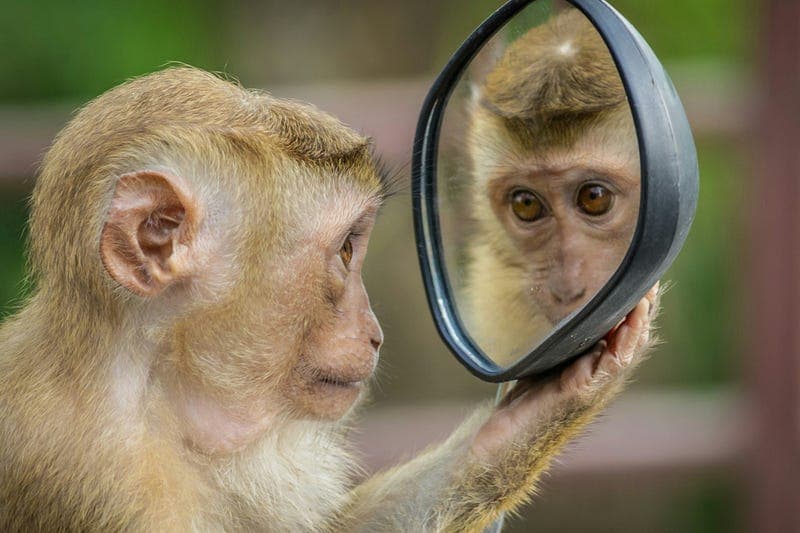
Andre Mouton on Unsplash
Self-awareness is usually framed as an unquestioned good. If you can reflect on yourself, observe your thoughts, notice emotional patterns, and understand your inner dynamics, you’re already ahead of the game. Most personal growth traditions treat this capacity almost like a superpower. And in many ways, it is.
But there is a part of this story that rarely gets talked about: metacognition is a sharp sword. And if you don’t know how to hold it, you will cut yourself with it again and again.
I know this because I did.
For a long time, I believed that becoming more aware of my thoughts would automatically make life easier. I assumed that if I could just understand why I felt the way I felt, the feeling would loosen its grip. If I could track a fear to its origin, name it correctly, contextualize it, and see through its irrationality, it would dissolve.
That belief sounded reasonable. It was also completely wrong.
The human brain does not work like a computer. You cannot simply delete a faulty line of code and replace it with a better one. Your brain does not lose memories unless there is actual physical damage. Instead, it keeps everything it has ever learned and builds new associations on top of existing ones. Old memories never truly disappear; they just become less dominant, sometimes lying dormant for long periods, only to reappear under the right conditions.
This is where metacognition becomes tricky. Because we don’t just have thoughts — we are aware of having thoughts. We can think about what we are thinking while we are thinking it. That recursive loop is what makes reflection possible, but it is also what opens the door to worrying, rumination, and endless internal debate.
The classic paradox captures it perfectly: “Don’t think of a white bear.” The instruction itself forces the image into awareness. Any attempt to push a thought away reminds the brain of what it is trying to avoid. Effort becomes fuel.
I learned this lesson painfully over the course of nearly eight years of struggling with anxiety. During that time, I consumed everything I could find. Books, podcasts, neuroscience, psychology, spirituality, trauma work. I genuinely believed I had seen it all and understood the problem inside out. And yet, something stubborn remained. Anxiety kept finding ways back in, often in subtler forms.
What finally shifted things for me was an anxiety coaching program I joined much later, at a point where I thought there couldn’t possibly be anything new left to learn. In hindsight, it wasn’t a complete overhaul that changed everything. It was the last missing five percent.
That five percent was learning to see my own metacognition as a pattern that was quietly keeping anxiety alive.
I realized that a large part of my “self-reflection” wasn’t neutral awareness at all. It was rumination dressed up as insight. My mind would constantly revisit the same themes, scan for problems, and rehearse old fears under the guise of being responsible, conscious, or thorough. I wasn’t avoiding anxiety anymore — I was maintaining it through attention.
That’s when I encountered a simple but profound idea: If you can’t delete, you can dilute.
You cannot erase old memories, fears, or conditioned responses. But you can weaken their influence. The brain learns through repetition and attention. Whatever you repeatedly engage with — especially emotionally — gets reinforced. Whatever you consistently disengage from begins to lose strength, not because it is gone, but because it is no longer dominant.
Putting this into practice was far harder than it sounds. When I first started disengaging from anxious rumination, it felt downright dangerous. My mind was so used to constant monitoring and problem-solving that stepping out of it triggered a deep sense of unease. It felt irresponsible, like I was missing something important or letting my guard down in a way that would surely backfire.
But I stayed with the process. I kept acknowledging what was there, labeling anxious thoughts as anxious thoughts, accepting their presence, and then deliberately disengaging from them. No arguing. No fixing. No analyzing. Just repetition of the same simple move, again and again.
After about three weeks, something shifted.
I could sense my brain starting to do this on its own. The volume of anxious thoughts dropped noticeably, and so did the emotional charge that came with them. The thoughts didn’t vanish, but they felt thinner, less convincing, less urgent. At times — especially in that in-between state between sleep and wakefulness, where anxious thoughts used to ambush me — I could almost feel my mind responding with something like, “Oh, this is old. We don’t need this pattern anymore.”
That moment mattered more to me than any insight I had before. It wasn’t intellectual understanding. It was embodied learning.
This is what healthy metacognition looks like in practice. It is observational rather than corrective. It creates space instead of pressure. It knows when reflection is useful and when it has crossed the line into self-surveillance.
The real shift was stopping the question, “Why am I thinking this?” and replacing it with, “Do I need to engage with this at all?” Very often, the honest answer was no. Awareness had already done its job.
Metacognition is not meant to be a constant internal commentary. It is a lens you can look through — and then put down again. Used skillfully, it helps you step out of old patterns and respond with more choice. Used compulsively, it keeps the nervous system on high alert and turns the mind into a problem that never quite gets solved.
The sword itself is neutral. What matters is how you hold it.
If you are naturally reflective, curious, and introspective, the work is not to become more aware. The work is to learn when awareness has done enough. That is where clarity lives — not in endless thinking about thinking, but in knowing when thinking is no longer needed.