Your Mind Doesn’t Just Imagine Danger. It Invents Necessity.
Anxiety doesn't only imagine threats — it invents rules you feel you must obey. How my world got smaller, and how I stopped mistaking those rules for facts.
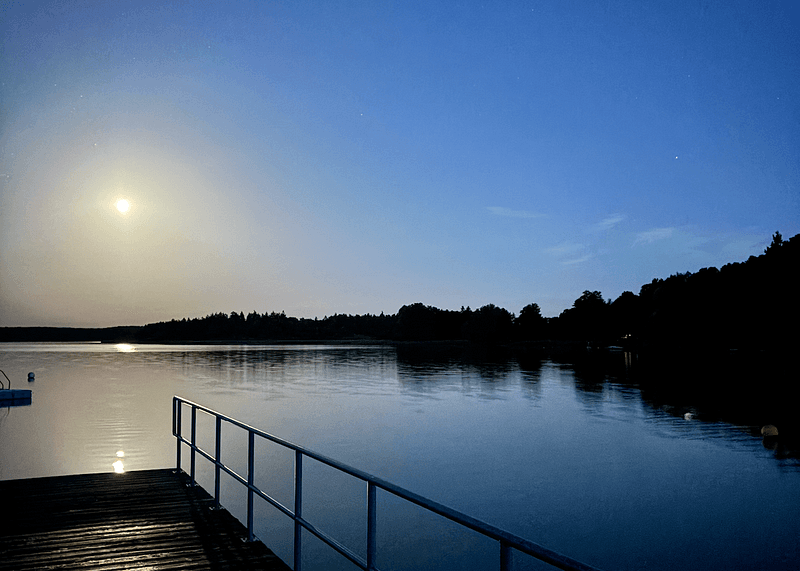
The moon gave me clarity ;)
When I fell into the anxiety cycle eight years ago, it felt like my world was getting smaller and smaller.
My family became the only place where I truly felt safe. My parents. My sister.
I would go on vacation with my parents in their camper van, bringing my tent along as we traveled through Croatia for weeks. As a man in his late thirties, there was always a voice in the back of my mind whispering, You should have built a family by now. You should be stronger than this. Look at you — you’re traveling with your parents.
Anxiety has a remarkable ability to turn thoughts into facts.
Over the years I noticed that certain things triggered me more than others. One of them was ugly places — run-down environments where it felt like people had simply stopped caring. Somewhere along the way I developed the belief that real healing meant becoming mentally strong enough to live in the most miserable conditions imaginable and still be perfectly okay.
It sounds admirable.
It also has very little to do with recovery.
Recovery isn’t about proving that nothing affects you anymore. It’s about helping your nervous system discover safety in places that once felt unsafe.
My mind, however, had different plans.
It believed healing required heroic acts.
Six weeks alone with a backpack through East Africa.
Four months in Portugal running a coliving retreat.
Big adventures. Big discomfort. Big proof that I had finally become “strong.”
None of those experiences healed me.
Most of them simply placed me in situations that I wasn’t ready to enjoy.
Looking back, I think I understand why.
Our beliefs slowly become our shoulds. They become the gatekeepers of happiness.
If I do X, then I’ll finally be happy.
If I do X, then I’ll finally be healed.
If I do X, then I’ll finally become the person I want to be.
Replace X with whatever achievement, relationship or experience your mind is chasing.
The promise is always the same.
The uncomfortable feeling you’re trying to escape will finally disappear.
The problem is that our minds are incredibly good at inventing necessities.
We convince ourselves that we need to do something before we can feel okay.
Then reality fails to deliver on that promise.
Instead of questioning the belief, we invent a new one.
And the cycle begins again.
Last weekend gave me another lesson in exactly this.
Germany was hit by a heatwave. The weather forecast had been warning about it for days, and before the weekend had even started, my mind had already created a story.
“I need to get out of the city.”
The moment I believed that thought, urgency appeared.
Urgency is anxiety’s favorite emotion.
Since I didn’t really know where to go, I remembered that my parents were staying with their camper van at a lake about two hours outside Hamburg.
Another thought appeared.
“It’ll be much better there. You’ll be in nature. You’ll be with your parents.”
It sounded perfectly reasonable.
But here’s something I’ve been learning recently.
We shouldn’t only question the information we receive from other people.
We should question the stories our own minds produce with the same honesty.
Had I done that before leaving, I probably would have discovered a very different truth.
The previous week had already left me exhausted after drinking more alcohol than I had promised myself I would.
I felt anticipatory anxiety about going to that particular lake because the last time I’d been there was years ago, when my anxiety was still severe.
Deep down, I didn’t even like that camping site. It was poorly maintained and I simply didn’t enjoy being there.
If I’m completely honest, I’ve never really liked camping all that much. I always thought I did because my parents loved it.
I love my parents dearly, but spending extended periods of time together can sometimes be exhausting.
And somewhere inside me, staying with them still occasionally touches the old identity of being “the broken son who can’t manage on his own.”
On top of all that, I felt guilty because my grandmother was struggling with the heat and I had postponed visiting her that week. While I was at the lake, the nursing home called to say they had to bring her to the hospital.
None of these things created the anxiety.
But together they painted a much more honest picture than the simple story my mind had offered me.
“Go to the lake. You’ll feel better.”
The drive there already felt difficult.
I could feel anxiety trying to build momentum. Intrusive thoughts came and went. I let them pass, but I also noticed another thought hiding underneath all of it.
“You have to endure this. You’re stronger now.”
What I never questioned was whether I actually wanted to be there in the first place.
The evening itself was nice enough.
We had a barbecue. Played cards. Laughed together.
Then came the night.
It had been almost 100°F (38°C) during the day, and for some reason I thought sleeping in a tent was still a brilliant idea.
The tent was unbearably hot.
I had to leave it completely open to get some air, which the mosquitoes appreciated far more than I did.
A party somewhere across the lake kept playing music until three in the morning.
I slept maybe two hours.
The next morning I woke up emotionally and physically drained.
For years I thought recovery meant not giving in to anxiety too easily.
I still believe that’s important.
But lately I’ve discovered another layer.
There is a fine line between avoidance and self-care.
Sometimes we aren’t avoiding something because we’re anxious.
Sometimes we simply don’t like it.
Anxiety often makes us distrust our own preferences.
It convinces us that every preference is weakness.
That if we don’t enjoy every environment, every challenge and every uncomfortable situation, then we still have more healing to do.
I don’t think that’s true anymore.
The truth is that I love beauty.
Not luxury.
Beauty.
Beautiful nature.
Beautiful buildings.
Places where people clearly care.
Beauty doesn’t have to be expensive, but I believe it nourishes something in us that we often underestimate.
I don’t enjoy neglected camping sites.
I don’t enjoy sleeping in sauna-like tents.
I don’t enjoy pretending that I should.
The greatest freedom I’ve found wasn’t becoming someone who could enjoy every place.
It was realizing I didn’t have to.
Recovery wasn’t about forcing myself to love camping, ugly surroundings or increasingly difficult challenges.
It was about learning to separate fear from genuine preference.
Anxiety had convinced me that every preference was something to overcome.
It wasn’t.
Some places genuinely give me energy.
Others drain it.
Some people leave me feeling more alive.
Others leave me exhausted.
Some environments allow my nervous system to expand.
Others make it contract.
None of that makes me fragile.
It makes me human.
Maybe that’s the deeper lesson.
An anxious mind doesn’t just imagine danger.
It invents necessity.
It tells us we need to leave.
We need to stay.
We need to prove ourselves.
We need to heal faster.
We need to become someone else before we’re allowed to be happy.
Most of those necessities exist only inside our own minds.
The more honestly we question them, the less power they have over us.
And perhaps that’s what healing really is.
Not becoming fearless.
But becoming less willing to mistake every thought for the truth.